

The Collective Spark: Why Innovation Teams Outshine the Solo Genius
Copyright by Stephan Klaschka 2010-2026

The Lone Genius in the Ivory Tower?
In the quest for organizational transformation, we often romanticize the lone inventor—the visionary in a garage who ignites a revolution. While the initial spark often comes from an individual, true, sustainable, and scalable innovation within an organization is the domain of the dedicated, cross-functional team.
At OrgChanger.com, we understand that culture eats strategy for breakfast. Similarly, a robust innovation system will always outperform a solitary idea, no matter how brilliant. If your goal is to transition from a single, high-risk bet to a reliable, continuous engine of change, the choice is clear: you need an innovation team.
The Fundamental Difference: Idea vs. Execution
The core distinction between the solo innovator and an innovation team isn’t just the number of people; it’s the shift in focus from Idea Generation to Disciplined Execution and Adoption.
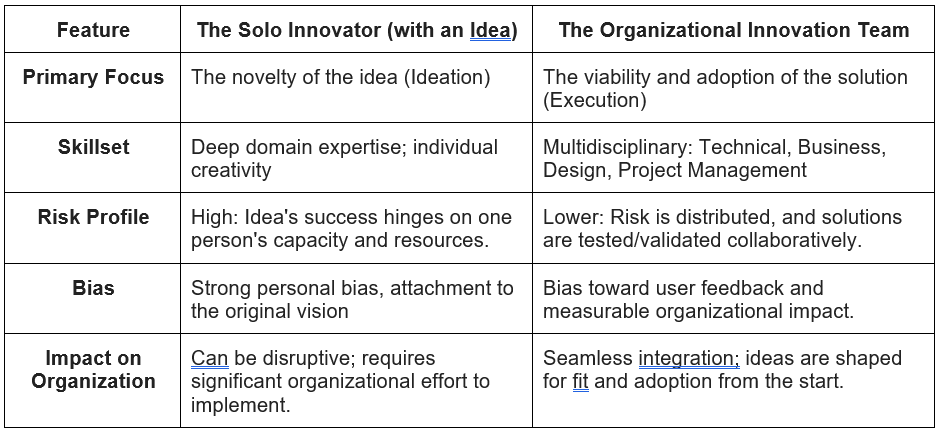
The solo innovator is defined by the “itch” to bring a concept to life. They are the source of radical, novel ideas. However, the organization’s ability to realize the value of that idea is closely linked to the group processes that drive execution—things like commitment to objectives, participation, and task orientation. An idea on a napkin is not an innovation until it is adopted and delivers value.
Why the Innovation Team is the Superior Organizational Model
For organizations seeking reliable, repeatable change, the innovation team model offers several critical advantages:
1. Breadth of Perspective and Skill
Innovation thrives at the intersection of disciplines. A solo innovator, by definition, has a limited view. A team, especially a cross-functional one (think Engineering, Marketing, Finance, and Customer Service reps), brings together:
Diverse Expertise: Ensuring technical feasibility, market alignment, and financial prudence are considered concurrently, not as afterthoughts.
Wider Empathy: Solutions designed collaboratively are more likely to reflect the diverse needs of the organization and the customer base, fostering an inclusive process.
“Checks and Balances”: Collaboration exposes flaws and stimulates creativity, ensuring the final product is more robust and better conceived than a solution built in a vacuum.
2. Enhanced Execution and Resilience
Ideas often fail in the transition from concept to reality. This is where the team structure becomes a non-negotiable asset.
Division of Labor: Teams can work on parallel streams (prototyping, market validation, business model development) to accelerate the development cycle.
Increased Resilience: If one team member hits an obstacle or leaves the project, the collective knowledge remains, preventing a single point of failure that could kill a solo project.
Built-in Accountability: Collective commitment to objectives and clear roles (e.g., Technical Lead, Research Lead, Project Manager) ensures the execution discipline required to get the job done.
3. Culture and Scalability
Perhaps most importantly from an organizational change perspective, the team model builds an innovative culture across the company.
Collaboration as a Muscle: Innovation teams break down silos, encourage cross-functional dialogue, and model a culture of shared value creation and risk-taking.
Organizational Adoption: Because various departments are represented on the team, they act as internal champions, ensuring the innovative solution is seamlessly adopted, rather than being viewed as an outsider’s mandate.
Scalable Knowledge: The process, learnings, and tools are documented and shared collectively, creating a repeatable framework for future innovation, turning a one-off event into a continuous capability.
The OrgChanger Takeaway
The solo inventor provides the spark; the innovation team provides the engine.
To move beyond incremental change and achieve value from your organizational culture work, you must transition from relying on the serendipitous brilliance of one person to investing in the systematic power of a team. Empowering small, dedicated, and diverse teams is the single most effective way to unlock your organization’s innovative potential, ensuring that your next great idea doesn’t just remain a concept, but becomes a transformative reality.
Ready to stop waiting for a genius to show up and start building an innovation system? Would you like to explore strategies for setting up your first cross-functional innovation team?
Thanks for following OrgChanger.com! Subscribe for free to receive new posts in your inbox.